Best Air Integrated Dive Computer in 2026
The Shearwater Perdix 2 Ti at $895 is the best air integrated dive computer for most divers who want one, paired with a Shearwater Swift transmitter at $445. Air integration displays cylinder pressure and a gas time remaining figure on the wrist, but it is not a gas plan: rock bottom from 100 feet in an aluminium 80 is about 33 cubic feet, roughly 1,300 psi, and that is where the dive ends.
Air integration puts cylinder pressure on the same screen as depth and no stop time, which removes an instrument from your kit and a step from every check you make underwater. It is a genuine convenience and it is not a gas plan, a distinction this page spends most of its length on. For divers who want it done properly the answer is the Shearwater Perdix 2 Ti at $895, plus a transmitter.
An air integrated dive computer is a dive computer that receives cylinder pressure, either through a high pressure hose in a console or wirelessly from a transmitter screwed into a high pressure port on the regulator first stage. Beyond displaying that pressure, most units derive a gas time remaining figure by combining your recent breathing rate with your current depth, and some fold that figure into their no stop calculation so the screen shows whichever limit arrives first.
Best air integrated dive computers by experience level

Suunto D5 Dive Computer
Colour screen, changeable straps and optional wireless tank pressure. The interface is a step up from the Zoop in both looks and menu depth.
Best for: Divers who want colour and air integration without Shearwater money

Aqua Lung i330R 2-Gauge Console Dive Computer
A colour console with four modes and three gas nitrox switching, plus Bluetooth to DiverLog. A console keeps depth, time and tank pressure on one hose, which is easier to teach and easier to read.
Best for: Divers who prefer a console and want colour and three gas support

Suunto Eon Core Wrist Dive Computer with Transmitter
A large colour screen with a customisable display and trimix support, sold here bundled with a tank pressure transmitter. Bulky on a small wrist, which is the honest cost of the screen size.
Best for: Divers who want air integration and a fully configurable display
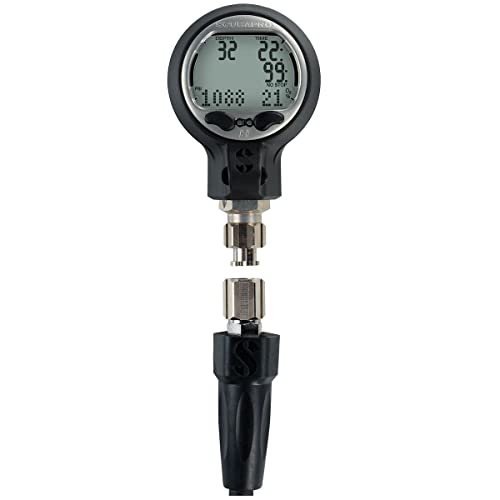
Scubapro Aladin H Matrix Dive Computer
A matrix display hoseless computer with a quick release mount and Scubapro predictive multi gas. It reads more like an instrument than a watch, which is the point.
Best for: Scubapro divers who want hoseless air integration

Shearwater Research Tern TX Dive Computer
The compact Shearwater. Watch sized with a colour AMOLED screen, air integration for two transmitters, and the same firmware and interface as the Perdix line at a smaller physical size.
Best for: Divers who want Shearwater firmware on a normal sized wrist

Shearwater Perdix 2 Ti Dive Computer
The large screen technical standard: titanium body, air integration, open and closed circuit, trimix, and a screen you can read through a flooded mask at depth.
Best for: Technical and cold water divers who want maximum legibility
Skip it if: Warm water recreational divers who will never use trimix or closed circuit support
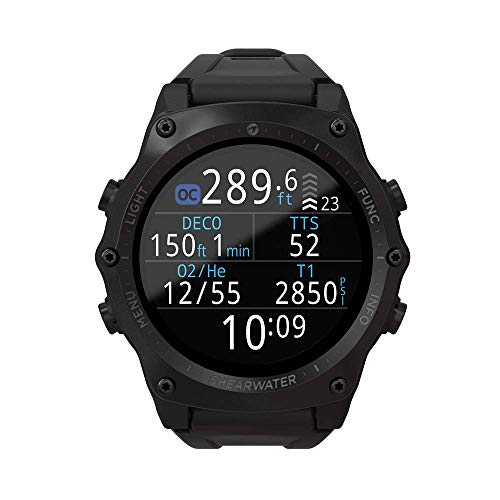
Shearwater Research Teric Dive Computer
A watch sized Shearwater with full trimix and closed circuit support, vibration alerts and wireless air integration for up to two transmitters. Genuinely more computer than recreational diving requires.
Best for: Technical divers, and recreational divers who will later become one
Skip it if: Divers who want the cheapest route to tank pressure on the wrist

Aqua Lung i770R Dive Computer with Transmitter
A colour wrist unit rated to 100 m with four gas nitrox switching, a rechargeable battery and a transmitter in the box. The Aqua Lung flagship, and priced with the technical units.
Best for: Aqua Lung divers who want colour and air integration in one purchase
Skip it if: Divers outside the Aqua Lung service network, since transmitters do not cross brands

Scubapro G2 Tek Wrist Dive Computer
The technical version of the G2: colour screen, trimix, closed circuit, up to three transmitters and a heart rate input. Comfortably more computer than any recreational profile needs.
Best for: Technical divers who want heart rate logged with the dive
Skip it if: Recreational divers, because trimix and closed circuit support is capability you pay for and never use

Shearwater Perdix 3 Dive Computer
The current large screen Shearwater, with an AMOLED display, air integration and open and closed circuit support. If you can read anything at all underwater, you can read this.
Best for: Technical divers who want the largest and brightest screen made
Skip it if: Anyone who can already read a Perdix 2 screen, which is essentially everybody
Specifications are the manufacturer's published figures, compared against verified owner reviews. Prices and stock change constantly, so confirm on the retailer page. Cards without a single listing link to a scoped search because that model is sold through dive shops. As an Amazon Associate we earn from qualifying purchases.
What does air integration actually do?
Three things, in descending order of usefulness.
It shows pressure without a separate instrument. Instead of finding a console, lifting it and reading it, the number is already on the wrist you were looking at for depth and time. On a task loaded dive, in a current, or with a camera in one hand, that is a real reduction in effort.
It logs pressure against the profile. Every dive comes back with a pressure curve aligned to depth, which is how a diver learns where their gas actually goes. Most divers discover that the answer is the descent and the first ten minutes, and that discovery is worth more than any equipment change.
It calculates gas time remaining. The computer watches your consumption over the last few minutes, scales it to ambient pressure at your current depth, and tells you how long the cylinder lasts if nothing changes. This is the feature that sells the category and the one that needs the most careful reading, which is the subject of a later section.
Hose or hoseless: which kind of integration should you buy?
A console routes a high pressure hose from the first stage to a unit you hold in your hand, with pressure, depth and no stop time on one face. The Aqua Lung i330R at $649 is the modern version: a colour screen, four modes and three gas nitrox switching. It costs $691.00 less than a Perdix 2 Ti and a Swift transmitter together, it never loses its signal, and its battery situation is simple.
Hoseless integration puts a transmitter on the first stage and a receiver on your wrist. There is one less hose to route and to snag, the display is where your eyes already are, and a single computer can often follow more than one cylinder, which is what matters if you dive stages or a pony. The costs are a second battery to manage, a radio link that can drop out, and a meaningful price step.
For a recreational diver who prefers everything on one hose, the console is not a compromise. It is heavier in the hand, it dangles unless you clip it, and it puts every number in one place, which is easier to teach and easier to read. For anyone heading toward technical diving, hoseless is effectively the standard, because the wrist is where the rest of the information already is.
Which transmitter do you need, and will it work with your computer?
Transmitters are brand locked and frequently model locked. This is the single most common expensive mistake in the category.
The Shearwater Swift at $445 pairs with the Shearwater line including the Perdix, Teric and Tern TX. The Oceanic transmitter at $399.95 pairs with air integrated Oceanic computers. Neither works with the other, and neither works with a Suunto or a Garmin. Check the exact model, not just the brand, before ordering.
Budget for the transmitter as part of the computer. A Perdix 2 with a Swift is $1,340.00, and a Tern TX with a Swift is $1,240.00. Some units bundle one, which is why the Suunto Eon Core at $699.95 and the Aqua Lung i770R at $1,148 look expensive against a bare computer and reasonable against a computer plus a transmitter.
Multi transmitter support means multiple cylinders, not redundancy. A Scubapro G2 Tek at $1,049 following three transmitters is built for a diver carrying stage or deco cylinders, not for a diver who wants two readings of the same tank.
| Computer | Price | Integration | Screen | Gas support | Best for |
|---|---|---|---|---|---|
| Suunto D5 | $348.99 | Optional wireless | Colour | Air and nitrox | Colour and air integration on a budget |
| Aqua Lung i330R | $649 | Console hose | Colour | Three gas nitrox | Divers who prefer a console |
| Suunto Eon Core | $699.95 | Transmitter included | Large colour | Trimix | Configurable display, bundled transmitter |
| Scubapro Aladin H Matrix | $729 | Hoseless | Matrix | Predictive multi gas | Scubapro service network |
| Shearwater Tern TX | $795 | Two transmitters | Colour AMOLED | Nitrox and technical modes | Shearwater firmware, normal wrist |
| Shearwater Perdix 2 Ti | $895 | Wireless | Large, high contrast | Trimix, open and closed circuit | Maximum legibility |
| Shearwater Teric | $1,199 | Two transmitters | Colour, watch sized | Trimix, closed circuit | A technical computer you wear daily |
| Garmin Descent Mk3i | $1,399.99 | T2 transmitter | Colour | Trimix, closed circuit | Divers inside the Garmin ecosystem |
Integration method, screen type and gas support are the manufacturers' published figures. Prices were checked at the time of writing, move constantly, and generally exclude the transmitter unless the listing states otherwise. Confirm on the retailer page before ordering.
Is gas time remaining a gas plan?
No, and treating it as one is the specific risk this feature introduces. Gas time remaining extrapolates your breathing rate over the last few minutes at your current depth. It assumes the next few minutes look like the last few, at the same depth, with the same workload, with nothing going wrong.
What it does not know is your reserve. Rock bottom is the gas two divers need to get from depth to the surface while sharing, with a safety stop: one minute at depth to solve the problem, an ascent at 30 feet per minute priced at the average depth of that ascent, three minutes at 15 feet, and the ascent from 15 feet to the surface, all of it for two divers at an elevated breathing rate of roughly 1.0 cubic feet per minute each rather than a relaxed 0.5, because a diver who has just run out of gas is not relaxed.
Worked, at 100 feet in an aluminium 80: roughly 33 cubic feet, which is about 1,300 psi. That is the pressure at which the dive ends, not a number to swim past, and no computer on this page will tell you it exists unless you configure it. Run your own depths and consumption through the gas planning calculator.
Your consumption figure underpins all of it, and there are two of them. SAC in psi per minute is the pressure you use per minute corrected to the surface. RMV in cubic feet per minute is the same thing expressed as a volume. RMV travels between cylinders and SAC does not, because a psi means a different quantity of gas in an aluminium 80 than in a steel HP100. Measure yours with the SAC rate calculator and convert before you compare anything.
What about nitrox limits on an air integrated computer?
Every computer here handles nitrox, and the limit that matters is oxygen partial pressure rather than gas volume. ppO2 equals the oxygen fraction multiplied by ambient pressure in atmospheres, and ambient pressure in ata is depth in feet of sea water divided by 33, plus one.
Maximum operating depth follows directly: MOD in feet of sea water equals 33 multiplied by the quantity ppO2 max divided by FO2, minus one. At the 1.4 ata working maximum, EAN32 gives 111 fsw, which is 33.8 metres, and EAN36 gives 95 fsw. At the 1.6 ata contingency ceiling, EAN32 gives 132 fsw, and 1.6 is an absolute ceiling used for decompression gas at rest rather than a target for the bottom phase of a dive.
Set the mix on the computer to match the analysed contents of the cylinder, every dive, and analyse every fill yourself. A computer set to air on a nitrox fill will run you a conservative but harmless profile; a computer set to EAN36 on an air fill will let you swim well past your real no stop time. The nitrox MOD calculator covers the arithmetic and the main dive computer roundup covers the units that are not air integrated.
How much does the algorithm and its conservatism setting matter?
A decompression algorithm is a mathematical model of how inert gas moves into and out of tissue compartments. Different models, and different conservatism settings within the same model, will give two divers on the identical profile no stop times that differ by tens of minutes.
Shearwater units run Buhlmann ZHL-16C with gradient factors, which is the model most technical divers use because it exposes the conservatism as two numbers you set rather than hiding it. Suunto and Mares run their own reduced gradient bubble models, and Scubapro and Oceanic each publish their own variants. None of them is wrong; they simply make different assumptions about bubble formation.
The practical consequence is that you must dive your own computer and follow it, rather than following the most permissive screen on the boat. Two buddies on different algorithms should plan to the more conservative of the two and ascend together, which is a conversation to have before the dive rather than at 60 feet. The Buhlmann versus RGBM comparison covers the differences in detail.
Set the conservatism once, deliberately, and leave it. Changing it between dives makes the repetitive dive picture harder to read, and the setting is a decision about how much margin you want rather than a number to optimise. Age, fatigue, cold, dehydration and hard work all argue for more margin, and none of them are inputs the computer can see.
Do you still need a mechanical pressure gauge?
Yes. A transmitter has a battery, a radio link and a receiving screen, and each is a way for your pressure reading to disappear. Transmitters drop out near camera strobes, near other transmitters on a crowded boat, and when the first stage ends up shielded behind a cylinder.
A Cressi Rugged Analogic Mini SPG at $109.95 is mechanical, cannot run out of battery, and clips out of the way. Divers who take gas planning seriously carry one regardless of what is on their wrist, and it costs a small fraction of the computer it backs up.
The rule to internalise is that a lost pressure reading ends the dive. That is a manageable outcome with a backup gauge in a pocket and an unpleasant one without.
Who should not buy the expert tier?
Skip the Shearwater Perdix 3 at $1,295 unless you have a specific reason to want an AMOLED screen. The Perdix 2 Ti at $895 is readable through a flooded mask at depth, which is the only legibility standard that matters, and $400.00 buys a brighter screen rather than a better computer.
Skip the Garmin Descent Mk3i at $1,399.99 unless you already live inside the Garmin ecosystem. Most of $504.99 over the Perdix 2 is being paid for surface features: training metrics, maps and notifications. They are good surface features and they do not change a dive.
Skip the Shearwater Teric at $1,199 if what you want is Shearwater firmware on a wrist sized case. The Tern TX at $795 delivers that for $404.00 less, with the same interface and two transmitter support.
Skip the whole category if you are a warm water recreational diver doing two trips a year. Air integration is convenience, and a mechanical gauge with a Suunto D5 at $348.99 costs a fraction as much and ends dives at the same pressure. The dive computer buying guide covers what actually differentiates units at every price.
Buying tips
- Price the transmitter into the decision. A bare computer plus a transmitter is often more than a bundled unit.
- Check model level compatibility, not brand level. Transmitters do not cross brands and sometimes do not cross generations.
- Keep a mechanical SPG. A lost radio link should cost you a dive, not a plan.
- Configure the reserve alarm on day one. Gas time remaining does not know your rock bottom until you tell it.
- Prefer legibility over resolution. The screen you can read through a flooded mask beats the one that looks best in a shop.
- Check the algorithm and its conservatism settings. Two computers on the same dive can differ by tens of minutes of no stop time.
Tank pressure transmitters

Shearwater Research Swift Transmitter
The Shearwater transmitter, which pairs with the Peregrine TX, Perdix, Teric and Tern TX. One transmitter per cylinder, and a computer can usually follow more than one.
Best for: Shearwater owners adding tank pressure to the wrist unit

Oceanic Wireless Transmitter
The Oceanic transmitter for the air integrated computers in that line. Check compatibility against your exact model before ordering, because transmitters do not cross brands.
Best for: Oceanic owners adding tank pressure
Specifications are the manufacturer's published figures, compared against verified owner reviews. Prices and stock change constantly, so confirm on the retailer page. Cards without a single listing link to a scoped search because that model is sold through dive shops. As an Amazon Associate we earn from qualifying purchases.
Deciding on a specific model? We review the Cressi Rugged Analogic mini SPG console review in full.
Frequently asked questions
What is the best air integrated dive computer?
The Shearwater Perdix 2 Ti at $895 is the best air integrated computer for most divers who want one: a titanium body, a screen legible through a flooded mask, wireless tank pressure, and firmware trusted across recreational and technical diving. It needs a Shearwater Swift transmitter at $445 on top. Divers who want the same firmware on a smaller wrist should look at the Tern TX at $795.
What does air integration actually do?
A transmitter screwed into a high pressure port on your regulator first stage reads cylinder pressure and sends it wirelessly to the computer, which displays it beside depth and no stop time. Most units also calculate a gas time remaining figure from your recent consumption rate. It removes one instrument from your kit and puts every number you need in a single glance.
Does air integration replace my pressure gauge?
It should not. A transmitter runs on a battery, communicates over a radio link that can drop out near strobes or other transmitters, and reports to a screen that can fail. A mechanical submersible pressure gauge such as the Cressi Rugged Analogic Mini SPG at $109.95 cannot run out of battery, and carrying one is standard practice among divers who take gas planning seriously.
Is gas time remaining a dive plan?
No. Gas time remaining extrapolates your recent breathing rate at your current depth and tells you when the cylinder empties. It does not know your reserve, your buddy, your ascent, your safety stop or your exit. Rock bottom, the gas two divers need to reach the surface sharing with a safety stop, is roughly 33 cubic feet from 100 feet in an aluminium 80, about 1,300 psi. That is where the dive ends.
Can I use any transmitter with any computer?
Almost never. Transmitters are brand locked and often model locked, so a Shearwater Swift pairs with Shearwater computers and an Oceanic transmitter pairs with Oceanic units. Check the exact model compatibility before ordering, not just the brand, and remember that a computer able to follow two or three transmitters means two or three cylinders on one dive rather than redundancy on one cylinder.
Is an air integrated computer worth the money for recreational diving?
It is a convenience purchase, not a safety purchase. Reading pressure at a glance genuinely reduces task loading and helps divers learn their own consumption faster, which is real value. It also adds a battery, a radio link and several hundred dollars to a kit that already had a working gauge. Buy it if you dive often enough that the convenience compounds, and keep the mechanical gauge either way.
How we choose: we compare published manufacturer specifications, published training agency standards, and verified owner reviews across retailers. We do not test gear in person, and every depth rating, cylinder capacity and algorithm name quoted here is the manufacturer's published figure unless we say otherwise, so confirm it on the current spec sheet before you buy. Nothing here is dive instruction, and no calculator output on this site is a dive plan. Scuba diving carries a real risk of decompression sickness, oxygen toxicity, barotrauma and drowning. Dive within the limits of your certification, verify every plan with your own computer, and buy the training before the gear that assumes it.
Logging your own SAC rate and gas plans? The Dive Kit & Air Planning Workbook is the paid version of these pages: 8 printable worksheets you fill in with your own numbers, plus the full PDF, $29.