Best Dive Knife and Line Cutter in 2026
The EEZYCUT Trilobite at $22.95 is the best cutting tool for most divers: a recessed double blade that mounts on a wrist or harness strap, works one handed in gloves, and cuts monofilament faster than a knife while being unable to cut you by accident. Mount any cutting tool above the waist, never on the calf.
A dive knife is a tool for cutting yourself free of things, not a weapon, and the version most divers picture, a large blade strapped to a calf, is close to the worst possible answer. The tool that actually solves entanglement is small, recessed and mounted where both hands can reach it. For most divers that is the EEZYCUT Trilobite at $22.95.
A dive cutting tool is anything carried specifically to free a diver from monofilament, net, rope or kelp: a knife, a shears, or a line cutter with a recessed blade behind a guard. The category exists because entanglement is one of the few underwater problems that gets steadily worse while you think about it, and because a diver who cannot reach a cutting tool with the hand that is still free has no cutting tool at all.
Best dive knives and cutters by experience level

EEZYCUT Trilobite Line Cutter
A recessed double blade cutter that mounts on a wrist or a harness strap and can be operated one handed with gloves on. It cuts monofilament and net faster than any knife and cannot cut you by accident.
Best for: Almost every recreational diver, as the primary cutting tool

Saekodive Line Cutter
A basic hook style cutter for net and rope. Adequate as a redundant tool clipped in a pocket, not as your only one.
Best for: A cheap second cutting tool
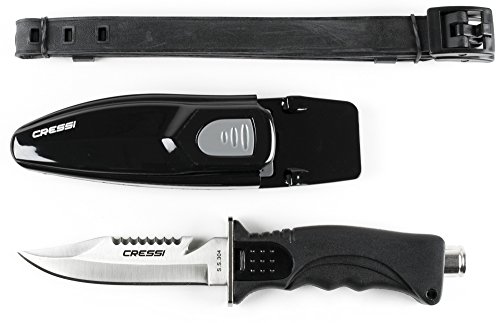
Cressi Skorpion Dive Knife
A conventional stainless leg or BCD knife with a serrated edge and a line notch. Stainless rusts if you do not rinse it, which is the honest trade for the price.
Best for: Divers who want a traditional knife as well as a cutter

Promate Sharp Tip Titanium Dive Knife
Titanium does not rust, which is the entire argument for the price step. A sharp tip is useful for prying and probing and useless for anything a diver should be stabbing.
Best for: Salt water divers tired of rusted stainless

Scubapro Mako Titanium Dive Knife
Titanium blade, a locking sheath that holds under load, and a BCD mounting kit in the box. The sheath is the part that justifies the price: a knife you lose is not a knife.
Best for: Divers who want one knife that stays in its sheath for a decade
Skip it if: Divers who want one cutting tool, because a wrist mounted line cutter reaches entanglement faster
Specifications are the manufacturer's published figures, compared against verified owner reviews. Prices and stock change constantly, so confirm on the retailer page. Cards without a single listing link to a scoped search because that model is sold through dive shops. As an Amazon Associate we earn from qualifying purchases.
Do you actually need a dive knife?
You need a cutting tool. Whether it is a knife is a separate question, and for most recreational divers the answer is no.
The threat is monofilament fishing line, gill net, polypropylene rope and, in temperate water, kelp. Wrecks accumulate all of it, piers and jetties are full of it, and reefs near any fishing community carry more than you would guess. Monofilament in particular is nearly invisible, does not break under hand tension, and tightens as you move.
What you do not need is a large blade. Nothing in recreational diving requires a weapon, marine animals are not the hazard divers imagine, and a big knife adds bulk, drag and one more thing to snag. It also has to be checked into hold baggage on every flight, which is a routine way to lose an expensive tool.
Carrying two cutting tools is worth the small money, and it is common practice among divers who spend time around wrecks. A Trilobite on the wrist plus a hook style line cutter at $22.95 in a pocket comes to $45.90, which is cheaper than most masks and buys you a tool reachable with either hand.
Line cutter or knife: which one gets you free faster?
A line cutter, in almost every realistic scenario. A recessed blade behind a guard pulls through monofilament and net with a single motion, works with cold hands in gloves, and cannot slip off the line onto a hose or a wrist.
The EEZYCUT Trilobite at $22.95 is the reference here: two replaceable blades recessed into a small body, mounted on a hook and loop strap that goes on a wrist or a BCD strap and comes off one handed. It is the tool most technical divers carry regardless of what else they have, and it is under twenty five dollars.
A knife still earns a place for jobs a cutter cannot do: sawing through thick rope, prying, or tapping the tank to get attention. The Cressi Skorpion at $39.95 covers that role with a serrated edge and a line notch, and a cutter plus a knife together comes to $62.90.
The one thing a knife should never be is your only cutting tool while it lives in a sheath you cannot reach with your left hand. That is the configuration that fails, and it fails at precisely the moment the tool exists for.
| Tool | Price | Type | Blade | Mount | One handed in gloves |
|---|---|---|---|---|---|
| EEZYCUT Trilobite | $22.95 | Line cutter | Recessed, replaceable | Wrist or strap | Yes |
| Saekodive Line Cutter | $22.95 | Hook cutter | Recessed | Pocket or clip | Yes |
| Cressi Skorpion | $39.95 | Knife | Stainless, serrated | Leg or BCD | With practice |
| Promate Sharp Tip Titanium | $129.95 | Knife | Titanium, sharp tip | Leg or BCD | With practice |
| Scubapro Mako | $169 | Knife | Titanium | Locking sheath, BCD kit | With practice |
Blade materials and mounting hardware are the manufacturers' published descriptions. The one handed column is a judgement based on the design and on verified owner reviews rather than a specification, and any tool is only one handed after you have practised it that way.
Where should you mount a cutting tool?
Above the waist, reachable with either hand. The inside of the forearm, a BCD waist strap or a shoulder harness are all correct. The calf is the mount everybody pictures and the one that fails.
Two reasons. First, the entanglement you cannot solve is the one you cannot see, and that is almost always behind your head at the tank valve, at the first stage, or across the shoulders. A diver held at the shoulders cannot fold themselves in half to reach an ankle. Second, a leg mounted knife is a snag point in its own right, sticking out into exactly the line and net you are trying not to swim into.
Mount it so the retention direction works with the pull. A tool that comes out with a downward motion when your hand is already low is faster than one that requires you to reposition. Then practise drawing it, in the water, in the gloves you actually dive, until it happens without you looking at it.
If you carry two, mount them on opposite sides. A cutter on the left forearm and one in a right hand pocket means no single trapped arm removes your ability to cut. That redundancy costs about twenty dollars and is the cheapest safety upgrade in this article.
How often should a cutting tool be checked and replaced?
Every dive for retention, every season for sharpness, and immediately after any use. A cutting tool is one of the few pieces of dive gear whose failure mode is silent: it sits in its sheath working perfectly right up until the day it does not.
Replaceable blade cutters make this straightforward, because the blades are consumable and cost very little. Change them when they stop pulling cleanly through a piece of scrap monofilament rather than waiting until they visibly corrode, and change both blades at once so the tool behaves the same in either direction.
Fixed blade knives need sharpening rather than replacing, and the serrated section needs a round file rather than a stone. Most divers sharpen the plain edge, ignore the serrations for years, and then discover that the part designed to cut rope is the part that no longer does.
The mounting hardware deserves the same attention as the blade. Hook and loop straps lose grip as they fill with sand, retention posts wear, and the small o rings inside some sheath locks perish in ultraviolet light. All of them are cheap to replace and all of them are the actual reason divers lose knives.
Titanium or stainless steel?
Titanium does not corrode in salt water. That is the entire argument, and it is a real one for anyone who has pulled a rust bloomed blade out of a sheath that never dried. The Promate Sharp Tip Titanium at $129.95 and the Scubapro Mako at $169 both trade on it.
Stainless takes a keener edge and holds it slightly better, and it costs a fraction as much. The price of that is maintenance: rinse it out of the sheath after every dive, dry it fully before it goes back, and oil it occasionally. A sheath that goes back on wet is a small salt water bath strapped to a blade, and it is where essentially all dive knife rust comes from.
The honest position is that $107.00 over a line cutter buys you freedom from a maintenance routine, not a better cut. If you rinse gear properly, stainless is excellent value. If you are the person who unpacks the dive bag the following weekend, buy titanium and stop thinking about it.
What makes a good sheath, and why does it matter more than the blade?
Because a knife you lose is not a knife. Sheath retention is the specification that separates tools that are still on your rig at the end of the dive from tools somebody finds on the bottom next season.
A good sheath locks positively, releases with a deliberate motion you can perform in gloves, and holds under load when a strap drags across it. A poor one relies on friction alone, which loosens as the plastic wears and as the o rings on the retention posts age. This is most of what the Scubapro Mako at $169 is charging for: a locking sheath and a BCD mounting kit in the box, rather than a better blade.
Whatever you buy, check the retention before each dive as part of the same pass where you check your light and your surface marker buoy . A tug on the handle takes one second and is the only test that matters.
What blade shape and size actually helps a diver?
Small, with a blunt tip and a serrated section. That combination handles every job a recreational diver genuinely has, and it removes the ones a diver should not be attempting.
Length is the first thing to get right. A blade of three to four inches cuts everything a diver encounters and stows somewhere reachable. Anything longer is drag, snag and hold baggage, and it exists because it looks the part rather than because rope requires it.
A blunt or chisel tip works as a pry bar and a scraper, will not puncture a BCD bladder or a drysuit when you fumble it in cold hands, and is safer to hand to a buddy. A sharp tip, as on the Promate Sharp Tip Titanium at $129.95, is genuinely better for probing and piercing and genuinely worse for everything else on a dive.
The serrated section is what actually cuts rope and net, because serrations bite into fibre rather than sliding along it. A plain edge is better on monofilament, which is why most dive knives carry both on opposite sides of the same blade. A line notch, the small hooked cut out near the handle, is the fastest way to take a single strand of monofilament without opening anything else.
The handle matters as much as the blade. It has to be usable in 5 mm gloves and it should have a hard butt cap you can tap against a cylinder to get a buddy's attention, which is a signalling tool most divers forget they are carrying.
Who should not buy the expert tier?
Skip the Scubapro Mako at $169 if you want one cutting tool and you want it to work. It is a genuinely good knife with a genuinely good sheath, and a wrist mounted line cutter still reaches an entanglement faster and works better with cold hands. $146.05 over the Trilobite buys a knife that stays put for a decade, which is a real thing to want and a poor first purchase.
Skip the Promate Titanium at $129.95 if you rinse your gear properly. Its advantage is corrosion resistance, and corrosion is a maintenance outcome rather than an inevitability. A $39.95 stainless knife that gets rinsed and dried outlives a titanium knife that gets ignored, because a neglected sheath ruins the mount and the strap regardless of what the blade is made of.
A newly certified diver should buy the Trilobite, mount it on the left forearm, practise the draw, and put the rest of the money into a dive light and the rest of the personal kit in the beginner gear package. Divers building a technical rig should see how cutting tools sit in the expert scuba setup.
Buying tips
- Buy a cutter before you buy a knife. A recessed blade handles monofilament and net faster and cannot cut a hose.
- Mount above the waist. Forearm, waist strap or shoulder. Never the calf.
- Carry two, on opposite sides. A trapped arm should not cost you your only tool.
- Practise the draw in gloves. A tool you have never drawn underwater is a tool you do not have.
- Check retention before every dive. One tug on the handle, every time.
- Pack it in checked baggage. Every blade, including recessed cutters, and check destination rules before travelling.
Deciding on a specific model? We review the SCUBAPRO Mako titanium dive knife review and Dive Rite ceramic line cutter review in full.
Frequently asked questions
What is the best dive knife for most divers?
For most recreational divers the best cutting tool is not a knife at all. The EEZYCUT Trilobite at $22.95 is a recessed double blade cutter that mounts on a wrist or a harness strap, works one handed with gloves on, cuts monofilament and net faster than a blade, and cannot cut you or your own hoses by accident. Divers who also want a traditional knife can add the Cressi Skorpion at $39.95.
Do I actually need a dive knife?
You need a cutting tool, which is not the same thing. Fishing line, net and rope are common on wrecks, piers and reefs, and entanglement is one of the few underwater problems that gets worse the longer you wait. A knife is one way to solve it and a dedicated line cutter is usually a faster one. A cutting tool is not a defensive weapon and nothing in recreational diving requires one.
Where should I mount a dive knife?
Somewhere both hands can reach: the inside of a forearm, a BCD waist strap, or a shoulder harness. The classic calf mount looks the part and is the worst option, because a diver entangled at the shoulder or the tank valve cannot bend to reach it and a leg mounted blade is itself a snag point. Mount the tool where the entanglement is likely to be, which is above the waist.
Titanium or stainless steel for a dive knife?
Titanium does not corrode in salt water, which is the whole argument for the price step, and it holds a slightly softer edge than good stainless. Stainless takes and holds a sharper edge and will rust if you rinse it carelessly, which most divers eventually do. If you rinse and dry religiously, stainless is excellent value. If you do not, titanium removes the maintenance question entirely.
Can I fly with a dive knife?
Only in checked baggage, without exception, and that includes line cutters with recessed blades. Some destinations restrict knife carriage more tightly than others, so check local rules before travelling, and consider whether a rental shop can lend you one instead. A confiscated knife at a security checkpoint is a routine and entirely avoidable way for a trip to start badly.
How do I keep a dive knife from rusting?
Rinse it in fresh water after every dive, out of the sheath, and dry it fully before it goes back in. A wet sheath holds salt water against the blade for days, which is where almost all rust actually forms. Oil a stainless blade occasionally with a light machine oil or a silicone spray. Sharpen it once a season, since a cutting tool that will not cut is only weight.
How we choose: we compare published manufacturer specifications, published training agency standards, and verified owner reviews across retailers. We do not test gear in person, and every depth rating, cylinder capacity and algorithm name quoted here is the manufacturer's published figure unless we say otherwise, so confirm it on the current spec sheet before you buy. Nothing here is dive instruction, and no calculator output on this site is a dive plan. Scuba diving carries a real risk of decompression sickness, oxygen toxicity, barotrauma and drowning. Dive within the limits of your certification, verify every plan with your own computer, and buy the training before the gear that assumes it.
Logging your own SAC rate and gas plans? The Dive Kit & Air Planning Workbook is the paid version of these pages: 8 printable worksheets you fill in with your own numbers, plus the full PDF, $29.